Can You Put a Fridge in a Skip Bin? What the Law Actually Requires
By Dylan Anderson ·
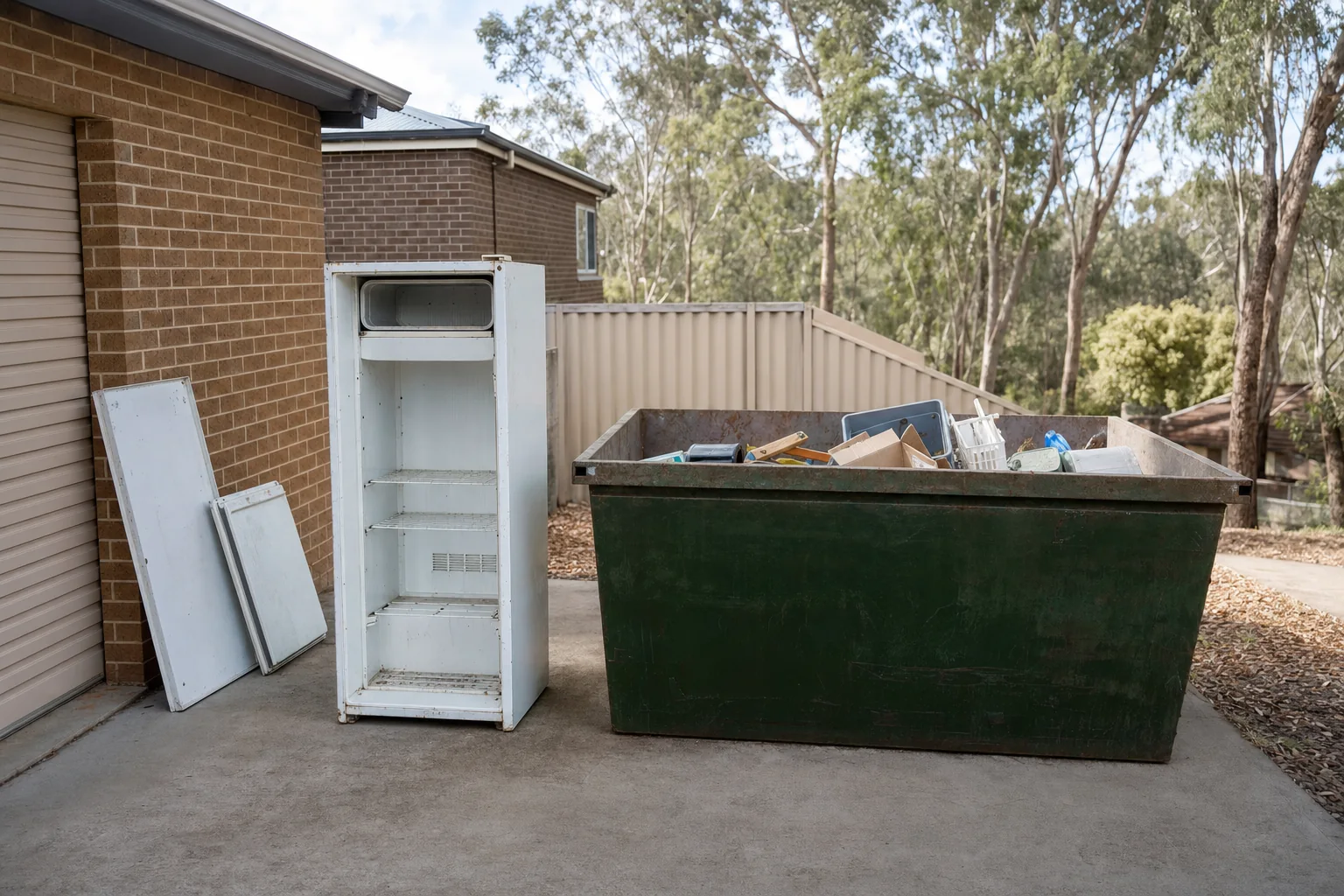
Not as it is. A working or recently working fridge still holds refrigerant gas, and that gas has to be recovered by someone licensed to do it before the fridge is crushed, shredded or scrapped. Once the refrigerant has been properly removed, what's left is essentially a metal cabinet, and the disposal question becomes a normal one.
So the honest answer is that it depends entirely on whether the fridge has been degassed, and on what your particular supplier accepts. Here's how the rules actually work and who they apply to.
Why a fridge is different to ordinary scrap metal
Fridges, freezers and air conditioners contain fluorocarbon refrigerant. The Australian Refrigeration Council, which administers the licence scheme on behalf of the Australian Government, puts it plainly: if you recycle or crush air conditioners or refrigerators, chances are those systems still contain fluorocarbon refrigerant gas, and all refrigerant should be recovered before recycling, repair or destruction.
The reason is environmental. Released into the atmosphere, these gases can damage the ozone layer and contribute to global warming. That's why they're controlled at the Commonwealth level rather than state by state, which makes this one of the few waste rules that works the same way everywhere in Australia.
What the law says
The Ozone Protection and Synthetic Greenhouse Gas Management Act 1989 and the Ozone Protection and Synthetic Greenhouse Gas Management Regulations 1995 control the manufacture, import, export, use and disposal of fluorocarbon refrigerant.
Two obligations matter here. Under section 45B(1) of the Act it is an offence to act in a way that results in the unlawful discharge of ozone depleting substances or synthetic greenhouse gases. And under Regulation 111 it is an offence to handle refrigeration and air conditioning equipment containing fluorocarbon refrigerant without a refrigerant handling licence.
The ARC lists the penalty for unlawful discharge as up to $132,000 for an individual and up to $660,000 for a corporation, as published on its penalties page in September 2026. Penalty amounts are indexed and change over time, so check the current figures rather than relying on this one.
ARC on penalties under the Ozone Act and Regulations
Worth being precise about who this lands on. The offence is discharging the gas or handling the equipment unlicensed, not the act of putting an appliance in a bin. In practice that means the exposure sits with whoever processes, crushes or scraps the fridge at the other end, which is exactly why waste operators are careful about accepting them.
Getting the gas out, legally
Hire an ARC-licensed technician
By law, anyone installing, repairing or decommissioning fridges and air conditioners containing fluorocarbon gas must hold a licence through the ARC. Licensed technicians have demonstrated they're qualified to handle the gas. The ARC runs a public directory for finding one.
Find an ARC-licensed technician or business
Get a Restricted Refrigerant Recovery Licence yourself
For people who regularly deal with decommissioned equipment rather than servicing it, the ARC offers a Restricted Refrigerant Recovery Licence, which covers recovering fluorocarbon refrigerant from decommissioned systems. A Restricted Refrigerant Trading Authorisation is required as well.
ARC information on the Restricted Refrigerant Recovery Licence
What happens to the recovered gas
Recovered refrigerant goes back to a wholesaler, where it's weighed and decanted, then collected by Refrigerant Reclaim Australia, tested and destroyed. Refrigerant Reclaim Australia is the industry-funded not-for-profit that runs the take-back scheme. Its 2021 fact sheet noted contractors receive a rebate per kilogram of recovered gas, so there's a financial incentive built into doing it properly.
Practical options for an old fridge
Most people don't need to organise a technician themselves, because there are pathways where the degassing is already handled.
- Council collections and waste facilities: many councils accept whitegoods, either through a booked kerbside collection or at a transfer station. Check what your council offers and whether it needs to be booked.
- Scrap metal recyclers: fridges are valuable as scrap, and operators set up for whitegoods will generally deal with the refrigerant as part of their process. Confirm before you turn up.
- Retailer take-back on delivery: some retailers will remove an old appliance when they deliver the new one. Ask at the point of sale rather than assuming.
- A licensed technician, then the shell: if the fridge is going in a bin or to a scrap dealer, get it degassed first and keep any documentation you're given.
Because council services, facility acceptance and retailer offers all differ by location and change over time, the only reliable answer is the one you get from your own council or the specific facility. We're not going to tell you what your council does.
If you're hiring a skip bin
Whether a degassed fridge can go in depends on the supplier, the bin type and the location, in the same way as any other restricted item. Ask when you book, and say plainly that it's a fridge and whether it's been degassed. That single question saves a lot of grief at collection time.
The same applies to the other things that commonly can't go in a general skip, including asbestos, chemicals, paint, gas bottles, liquids, tyres and medical waste. These usually need a licensed facility rather than a bin.
Ask us about a specific item before you book
Two safety points
Don't cut, puncture or disconnect refrigerant lines yourself. That's the discharge the law is aimed at, and it's also how people get hurt. Leave it to someone licensed.
An old fridge left standing with its door still attached is a hazard around children, which is why some councils require doors to be removed before a hard rubbish collection. Yarra Ranges Council in Victoria explains the reasoning directly: children have been known to hide in fridges and become trapped inside. If a fridge is going to sit in a yard or driveway waiting for collection, take the door off first.
Yarra Ranges Council on why fridge doors must be removed
The short version
A fridge with gas still in it doesn't belong in a skip bin. Refrigerant has to be recovered by someone holding an ARC licence, because unlawful discharge is an offence under Commonwealth law with substantial penalties attached. Once it's been degassed, the fridge is scrap metal, and whether it can go in your bin comes down to your supplier, the bin type and where you are.
If you're clearing out a house or a granny flat and there's an old fridge in the mix, tell us before the bin turns up and we'll sort out the right approach for your location. You can check bin sizes and get a price on our booking page.