Illegal Dumping in Australia: What Counts and What It Costs in 2026
By Dylan Anderson ·
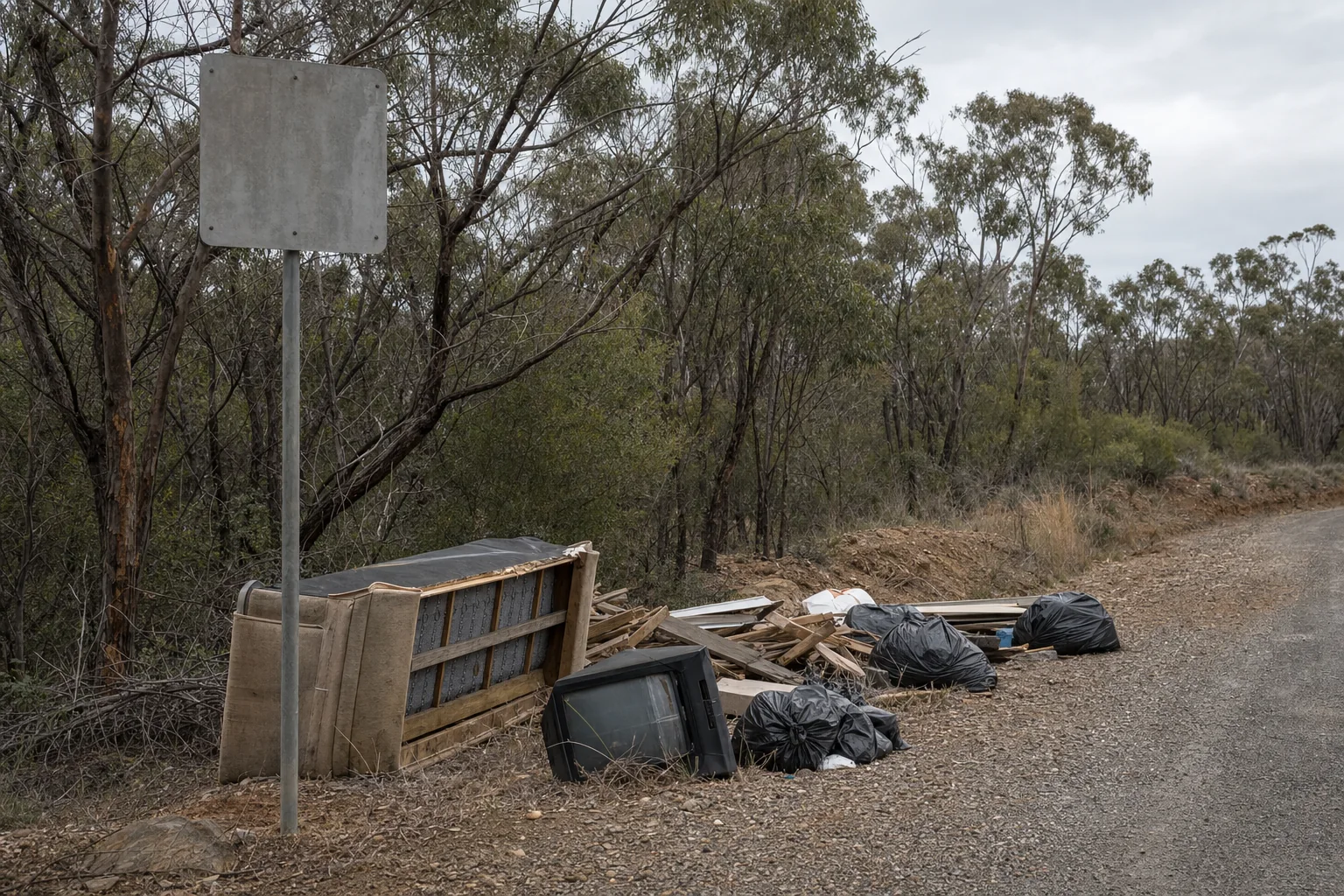
Queensland councils cleaned up 13,107 tonnes of illegally dumped waste in a single year. That's more than 1,200 garbage truck loads of other people's rubbish, paid for by ratepayers.
On 8 September 2026 the Queensland Government announced $13.7 million over three years for 52 councils to fight it, funding dedicated compliance officers, surveillance equipment and night-time operations at known hotspots. Nearly half the funded projects include targeted night surveillance. It's part of the Fighting Illegal Dumping Partnership Program, launched in January 2026 with $17.7 million.
Illegal dumping is environmental vandalism that harms local communities, damages the environment and leaves ratepayers footing the bill. Andrew Powell, Queensland Minister for the Environment and Tourism, September 2026.
If cameras are going up where you live, it's worth knowing where the line actually sits. A lot of what counts as illegal dumping isn't what people picture.
What legally counts as illegal dumping
There's no single national definition. Each state sets its own thresholds, and they're further apart than you'd expect.
Queensland: measured in litres
Under the Waste Reduction and Recycling Act 2011, illegal dumping means unlawfully depositing 200 litres or more of waste, which the state describes as roughly a wheelie bin's worth. Anything under 200 litres is littering, a separate offence. There's a second tier at 2,500 litres and over, and a distinct offence of dangerous littering for waste likely to cause harm, such as a lit cigarette thrown onto dry grass or a syringe left in a public place.
New South Wales: measured in litres or kilograms
The NSW EPA explains that under section 144AE of the Protection of the Environment Operations Act 1997, depositing more than 50 litres or 50 kilograms of litter or waste in or on a public place, or an open private place, is an offence. Penalties are higher for a sensitive place as defined in the legislation. Sections 143 and 144 cover unlawful transporting, acceptance and depositing of waste, and the EPA notes the owner, the transporter and the person receiving the waste can all be committing an offence.
Victoria: measured by where it lands
EPA Victoria frames it without a volume test at all. You break the law if you dump, abandon or bury any kind of waste at a place not authorised to accept it, and that explicitly includes private land.
What it costs
Queensland penalties, 1 July 2026 to 30 June 2027
Queensland publishes its penalty amounts as a dated table, which makes them unusually easy to check.
- General littering: $345 infringement for an individual, $1,720 for a corporation. Maximum in court $5,181 and $25,905.
- Dangerous littering: $690 infringement for an individual, $2,763 for a corporation. Maximum in court $6,908 and $34,540.
- Illegal dumping under 2,500 litres: $2,763 infringement for an individual, $8,635 for a corporation. Maximum in court $69,080 and $345,400.
- Illegal dumping of 2,500 litres or more: $3,454 infringement for an individual, $12,952 for a corporation. Maximum in court $172,700 and $863,500, or twice the waste levy avoided, whichever is greater.
- Failing to comply with a clean-up notice: $1,727 infringement for an individual, $8,635 for a corporation.
Queensland litter and illegal dumping legislation and penalty table
New South Wales penalties
The NSW figures escalate sharply with scale. For small-scale dumping the on-the-spot fine is $1,000 for an individual, or $2,500 in a sensitive place, with maximums of $25,000 and $50,000. For larger-scale offences the on-the-spot fine is $15,000 for an individual and $30,000 for a corporation.
At the top end, the maximum penalty for larger-scale strict liability dumping is $500,000 for an individual, with a further $120,000 a day for a continuing offence, and $2,000,000 for a corporation with a further $240,000 a day. Where the waste contains asbestos, the EPA states the maximum penalty doubles. Wilful or negligent disposal causing actual or likely harm to the environment carries a maximum of $2,000,000 and up to seven years imprisonment for an individual.
NSW EPA illegal dumping laws and penalties
Penalty amounts are indexed and change, and the figures above are as published by each regulator in September 2026. Check the current numbers rather than relying on these.
The things people don't realise count
This is where most accidental offending happens, and none of it involves a ute at midnight.
- Leaving items on the footpath outside an organised collection day. Queensland classes this as illegal dumping.
- Leaving donations outside a charity bin or shop when it's full. Queensland names this specifically, and notes it costs charities thousands to clean up.
- Waste that escapes in transit. EPA Victoria points out you must make sure your waste does not become litter, and waste duties apply to anyone who generates, transports or receives it.
- Waste abandoned by a tenant. EPA Victoria warns landlords may be left with legal liability for cleaning up and managing waste a tenant abandons, including contaminated land obligations.
- Accepting fill or waste from someone else onto your land without checking what it is.
Is enforcement actually working?
There's real evidence on this. In February 2026 the NSW EPA released the state's most comprehensive study of illegal dumping, published every five to six years.
Dumping by community members fell from 22 per cent in 2019 to 13 per cent. Kerbside dumping by community members dropped from 20 per cent to 10 per cent, and from 17 per cent to 10 per cent for businesses. Awareness that kerbside dumping is illegal rose from 48 per cent to 75 per cent. Business dumping, though, held steady at 26 per cent.
The cost hasn't gone away. The EPA reported that 98 per cent of councils identify illegal dumping as an issue in their area, with one in seven spending more than $500,000 a year on clean-up and enforcement. Bulky household items remain the most dumped material, and kerbsides, roadsides and bushland the worst hotspots. Since penalties were strengthened in April 2024, the EPA said it had issued 26 penalty notices for illegal dumping totalling $446,750.
NSW EPA on its 2026 illegal dumping research findings
How to report it
Reports are what direct where cameras and officers get deployed, so they genuinely matter. Councils handle most local reports, and state regulators take them too.
Report littering and illegal dumping in Queensland
Report illegal waste dumping in Victoria
If waste has been dumped on your property, or in a bin you've hired, the same reporting channels apply.
Staying on the right side of it
The Queensland Government makes a fair point about motive: people dump on the spur of the moment, to avoid disposal fees, or because proper disposal seems like too much effort, when legal disposal often would have cost less in fuel, time and effort than the dumping did.
The practical version is simple. Use a licensed facility or a hired bin, keep whatever receipt or docket you're given, don't hand your waste to anyone who can't tell you where it's going, and don't leave anything on a footpath or beside a charity bin outside a scheduled collection.
If you've got a clean-out coming up and you're not sure what your options are where you live, check sizes and pricing for your address, or ask us what to do with anything unusual in the pile.