Someone Put Rubbish in My Skip Bin. What Can You Actually Do?
By Dylan Anderson ·
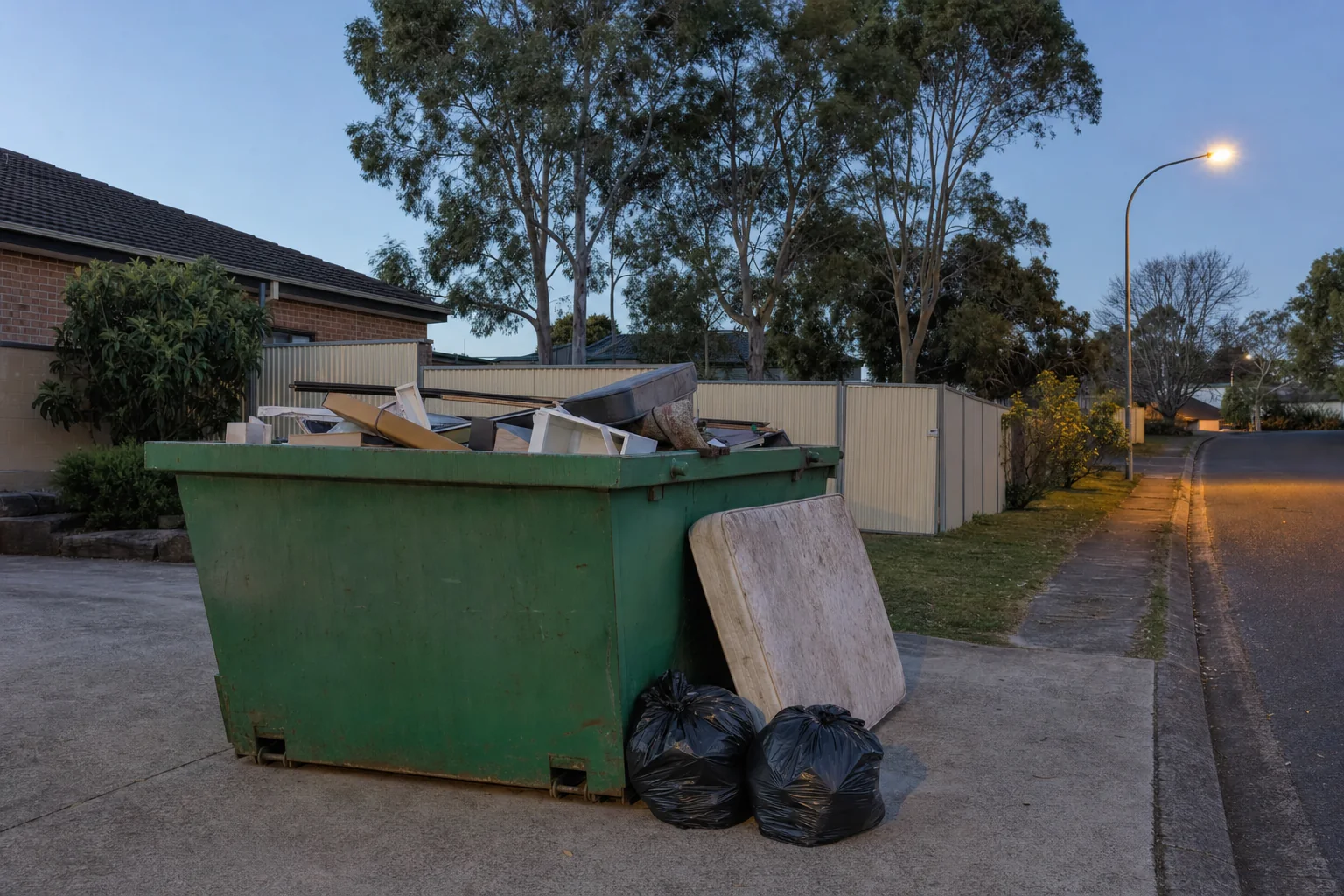
You hire a bin for a weekend clean-out, and by Monday there's a mattress in it that isn't yours. It's one of the more common complaints in this industry, and most people assume it's just bad luck. It isn't. Depending on where you are and how much was tipped in, it can be an offence.
Here's what the law says, what it can cost you as the person who hired the bin, and the practical things that cut the risk.
Dumping in someone else's bin can be an offence
The detail differs by state, so the rules where you are matter more than any general statement. Three examples show how it's framed.
New South Wales
The Protection of the Environment Operations Act 1997 is the main law. The NSW EPA explains that under section 144AE it is an offence to deposit more than 50 litres or 50 kilograms of litter or waste in or on a public place, or an open private place. That second category is the one people miss, because a driveway with a skip on it can fall within it.
The EPA lists on-the-spot fines of $1,000 for an individual where waste is dumped on other public land or open private places, rising to $2,500 if it's a sensitive place as defined in the Act. For corporations the equivalent figures are $5,000 and $10,000. Maximum penalties for the small-scale offence run to $25,000 for an individual and $50,000 for a corporation, doubling for sensitive places.
NSW EPA on illegal dumping laws and penalties
Queensland
Queensland uses a volume threshold. Under the Waste Reduction and Recycling Act 2011, illegal dumping means unlawfully depositing 200 litres or more of waste, which the state describes as roughly the volume of a wheelie bin. Below that it's littering, which is a separate offence with its own penalties.
Queensland Government on illegal dumping
Victoria
EPA Victoria puts it broadly: you break the law if you dump, abandon or bury any kind of waste at a place not authorised to accept it, and it states explicitly that this includes private land.
EPA Victoria on dumped waste and the law
Why it lands on you, not them
The practical problem is that the bin is hired in your name and the load leaves with your job attached to it. A few things can change as a result:
- Weight. A dumped mattress or a few bags of soil push the load toward the weight limit you were quoted against.
- Classification. If you booked a clean green waste or clean brick and concrete load, general rubbish tipped in overnight changes what that load is.
- Restricted items. If someone puts a gas bottle, paint tins, tyres or anything containing asbestos in your bin, that becomes a problem at the tipping floor even though you never touched it.
- Fill line. Waste added above the rim means the bin can't be safely covered and transported.
How any of that is handled comes down to your hire agreement and your supplier, so read the terms and raise it early rather than at collection. We're not going to tell you what someone else's contract says.
What to do if it happens
- Photograph the bin before you touch anything, with a wide shot and a close one. A timestamped photo is far more useful than a description later.
- Don't go through the waste looking for names or addresses, and don't confront anyone. If there's something identifying in there, that's for the council or the EPA to deal with.
- Tell your supplier as soon as you can, before collection rather than after. This matters most if something restricted has been added, because it changes how the load has to be handled.
- Report it to your council or state environment regulator. Reports are what drive where surveillance and enforcement resources go.
- Only remove items yourself if they're safe to handle. Don't move anything you suspect contains asbestos, and don't handle chemicals, gas bottles or sharps.
Where to report it
Councils handle most local reports, and state regulators take reports too. Start with whichever covers where you are.
Report littering and illegal dumping in Queensland
Report illegal waste dumping in Victoria
Reducing the risk before it happens
None of this is foolproof, but the pattern is consistent: bins that are visible, occupied and not sitting idle attract less of it.
- Put the bin on your property rather than the kerb where access allows it. A bin on a driveway behind a gate is a much harder target than one on a nature strip.
- Time the delivery close to when you'll actually start. An empty bin sitting for three days before you touch it is an invitation.
- Fill it as you go. A visibly full bin is less attractive than a half-empty one.
- Think about the weekend. If the job runs over, that unattended Saturday night is when most of it happens.
- Ask your supplier what's available for your situation, including placement advice and whether any covering options exist for the bin type you're hiring.
If the only place a bin can go is the road, the footpath or the nature strip, check whether your council requires a permit for that, because rules differ between councils.
What about people taking things out?
The other half of this question comes up constantly, and there isn't a tidy national answer. The sensible position is that the bin and what's in it are in your control while it's on hire, so anyone who wants something out of it should be asking you first. If you're happy for usable items to find a home, leaving them beside the bin rather than in it makes that easy and keeps your load clean.
The short version
Someone tipping their rubbish into your hired bin isn't just rude, and in several states it can meet the legal definition of illegal dumping, including when the bin is sitting on private property. Photograph it, tell your supplier before collection, report it to your council or regulator, and don't handle anything hazardous.
If you've had it happen and you're unsure how it affects the load you booked, tell us what turned up and we'll work out the right approach before the truck arrives.