Can You Put Batteries in a Skip Bin? What Changes in NSW on 1 October 2026
By Dylan Anderson ·
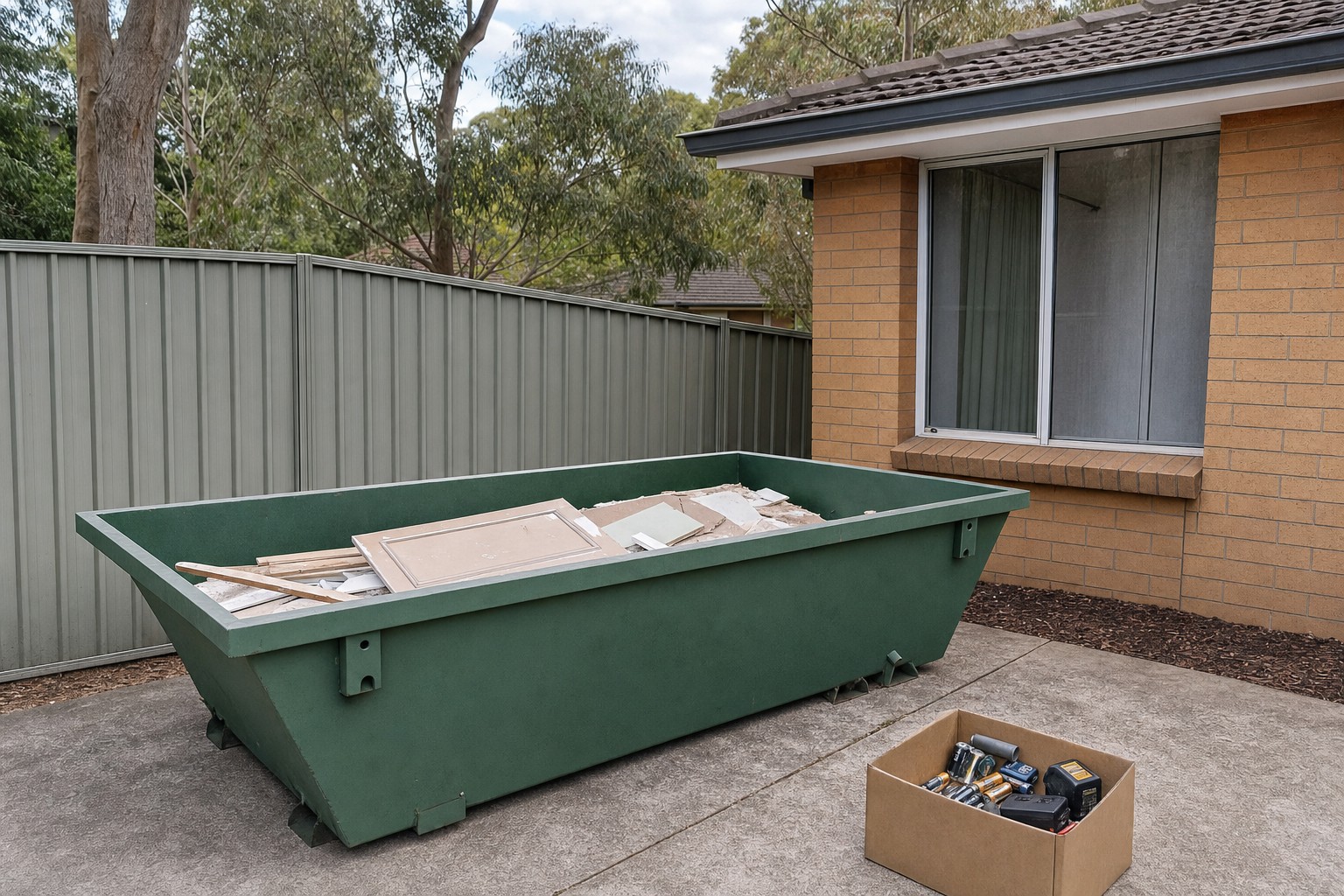
Short answer: no. Batteries don't go in a skip bin, and that holds for every bin size, every waste type and every state.
From 1 October 2026, NSW goes further on this than any other state. A new regulation makes the companies that sell batteries legally responsible for collecting and recycling them at the end of their life. Here's what's driving the change, and what to do with the old batteries you turn up when you're clearing out a house or finishing a renovation.
Why batteries can't go in a skip bin
Most skip loads don't go straight to landfill. They get tipped, sorted and often compacted, and that's where the trouble starts. A lithium-ion battery that gets crushed or punctured can go into thermal runaway, which is a fast, extremely hot fire that's very hard to put out and can reignite hours later.
Buried in a mixed load, one battery is close to impossible to spot before it's too late. The fire can start in the truck, on the tipping floor, or deep inside a stockpile at a transfer station where it can smoulder for days before anyone sees smoke.
The NSW numbers show the scale of it. Fire and Rescue NSW recorded 332 lithium-ion battery related incidents in 2025. By early April 2026 there had already been 62 battery fires in the community and at least 12 in garbage trucks, waste facilities and tips, with a further 103 waste industry fires suspected to involve batteries.
These fires are hot, fast and incredibly difficult to put out. Penny Sharpe, NSW Minister for the Environment, April 2026.
NSW Government media release on the battery reforms
What changes in NSW on 1 October 2026
NSW passed the Product Lifecycle Responsibility Act 2025 and has made a regulation under it that is expected to commence on 1 October 2026. It makes NSW the first state in Australia to require battery product stewardship by law rather than leaving it voluntary.
The obligation sits with the companies that supply batteries, not with you. Brand owners have to take part in a stewardship scheme and pay a fee on the batteries they sell, and that money funds collection points, recycling and public education. The EPA also gets annual reporting on how many batteries are supplied in NSW and how the scheme is performing. Suppliers who don't comply face penalties of up to $880,000.
For households, the practical effect should be more places to drop batteries off and better information about where they end up. The rule about your skip bin doesn't change. Batteries stay out.
Which batteries the new rules cover
- Small removable batteries under 5kg, including AA, AAA, C, D and button batteries
- Rechargeable batteries you can take out of a device
- Power banks
- Batteries used in e-bikes and e-scooters
Where to take batteries instead
Loose batteries under 5kg
These go to B-cycle, the national battery stewardship scheme, which is authorised by the ACCC. Drop-off points are hosted at many supermarkets, hardware stores and electronics shops, so there's a reasonable chance there's one within a few minutes of you. Use the map to find the closest.
Service NSW guide to household battery recycling locations
Larger removable batteries, 5kg to 20kg
Think removable e-scooter and e-bike batteries, cordless vacuum batteries and batteries from larger power tools. In NSW these can go to a Community Recycling Centre or a Household Chemical CleanOut event, free of charge.
Find a Community Recycling Centre or CleanOut event in NSW
Batteries built into a device
Embedded batteries are the ones you can't get out: electric toothbrushes, bluetooth speakers, smart watches, cordless vacuums, vapes and many power banks. These are particularly risky in a bin because the device combines a lithium battery with a heating element or circuitry that can ignite during collection or processing. Take the whole item rather than trying to prise the battery out. The NSW EPA is currently trialling free collection of embedded batteries at selected Community Recycling Centres, and collection of vapes at Household Chemical CleanOut events.
Batteries B-cycle doesn't accept
B-cycle drop-off points don't take vapes, solar panel batteries, home energy storage systems, caravan batteries or batteries embedded in devices. Service NSW also lists mobile phone, laptop and TV batteries, lead-acid batteries and exit lighting as outside the B-cycle drop-off network. There are separate options for most of these:
- Lead-acid batteries, including car batteries: ABRI drop-off points, or a Household Chemical CleanOut event
- Mobile phone batteries: MobileMuster
- Laptop and computer batteries: the National Television and Computer Recycling Scheme
- Anything you're not sure about: ask your council or your local transfer station before you move it
Handling batteries safely before you drop them off
- Tape the terminals with clear sticky tape. AA style batteries have a terminal at each end, a 9V has both terminals together at one end, and a button battery needs its base covered all over.
- Store them in a ventilated container until you can drop them off. Glass works well. Keep it away from anything flammable.
- Don't leave them sitting in direct sun or in a hot car for long stretches.
- Keep any swollen, bulging or visibly damaged battery separate from the rest, and ring the drop-off point first to ask how they want it handled.
What this means when you book a skip
The easiest approach is to sort as you go. Put a box aside at the start of the clean-out and drop every battery into it as you empty drawers, sheds and garages. Kitchen drawers and garage shelves are where most of them hide.
It's worth remembering that accepted waste varies by supplier, bin type and location, so batteries are not the only thing to check. Asbestos, chemicals, paint, gas bottles, liquids, tyres and medical waste are commonly excluded from general skips and usually need a licensed facility. If you're unsure about an item, ask before it goes in rather than after.
Ask us about a specific waste type
Two other things that catch people out: the fill line and the weight limit. Loading above the rim means the bin can't be safely covered or transported, so it may not be collected. Heavy materials like soil, brick and concrete reach the weight limit well before the bin looks full, which is why mixed heavy waste is usually quoted differently.
How skip bin hire pricing works in Australia
Fire risk hotspots in NSW
The EPA and Fire and Rescue NSW are running a public campaign called Never Bin a Battery, aimed squarely at keeping batteries out of household bins. As part of it, campaign decals are going on fire trucks across the five local government areas with the highest number of lithium-ion battery fires: the City of Sydney, Canterbury-Bankstown, Cumberland, Blacktown and the Central Coast.
If you're clearing out a property in one of those areas, the battery sweep matters more than most.
NSW EPA Never Bin a Battery campaign
If you're outside NSW
The legal detail above is specific to NSW, and it's worth being clear about that. NSW is the first state to make battery stewardship mandatory, so the commencement date, the penalties and the reporting obligations apply there and not elsewhere.
The practical advice travels fine. B-cycle is a national scheme with drop-off points in every state and territory, and skip bin suppliers around the country exclude batteries from general bins. Check your council or your state environmental regulator for local drop-off options and any rules that apply where you are, because waste regulations differ from one state and one council to the next.
The short version
Batteries never go in a skip bin. From 1 October 2026 the companies selling them in NSW carry a legal duty to fund their collection and recycling, which should mean more drop-off points and clearer information over time. In the meantime, loose batteries under 5kg go to a B-cycle point, larger removable ones and whole devices go to a Community Recycling Centre, and terminals get taped before anything moves.
If you've got a clean-out or a renovation coming up, do the battery sweep before the bin turns up. It takes about ten minutes and it keeps a genuinely dangerous item out of the waste stream. You can check bin sizes and get a price on our booking page, and if you're not certain whether something belongs in your bin, ask first and we'll tell you.