How Much Does a Skip Bin Cost in Australia? 2026 Price Guide
By Dylan Anderson ·
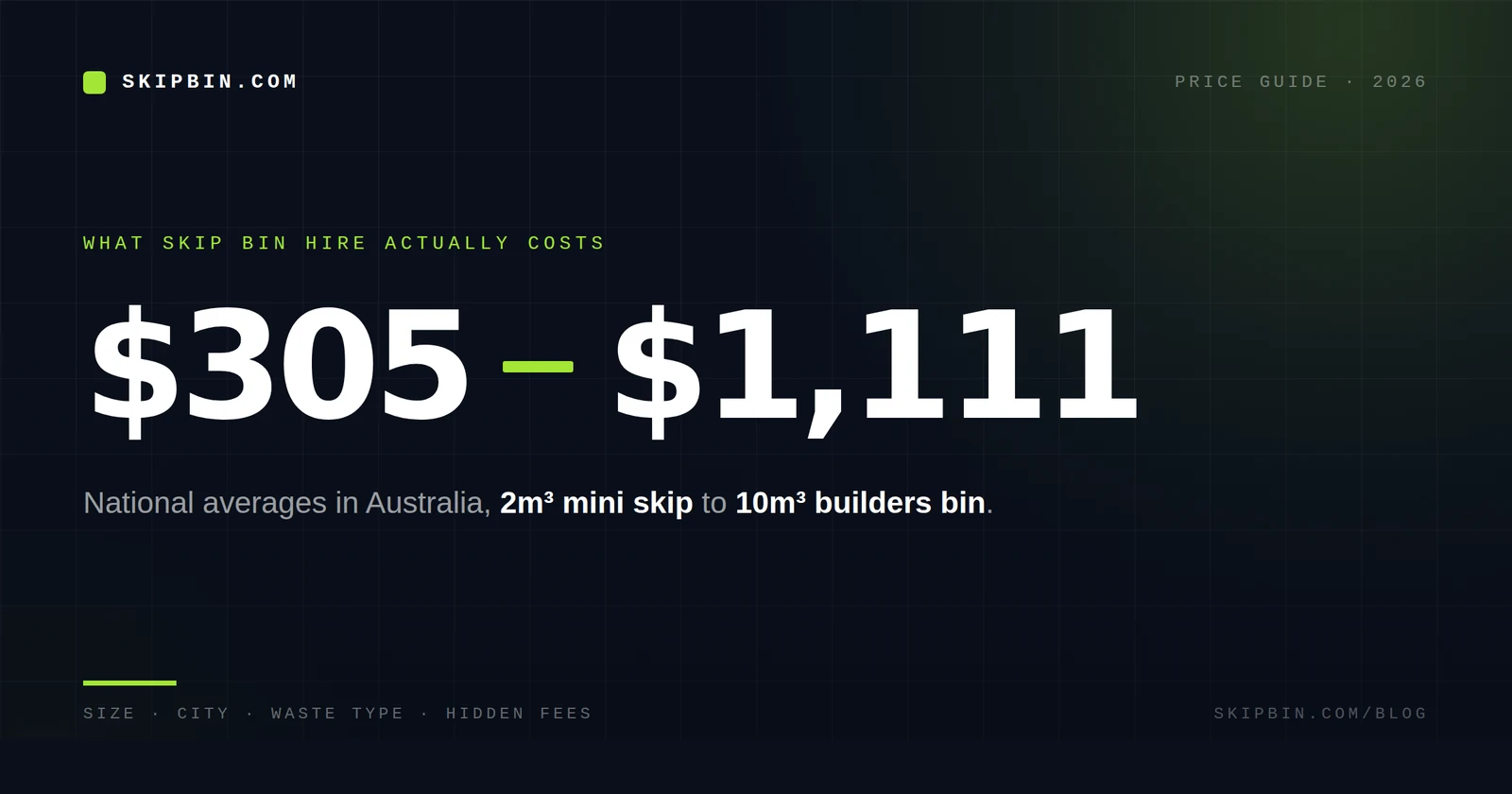
Skip bin hire in Australia typically costs between $200 and $1,200, depending on the size of the bin, the type of waste going into it and where you live. As at September 2026, the national average sits at roughly $305 for a 2m³ mini skip, $534 for a mid-size 4m³ bin and $1,111 for a 10m³ bin. Most operators include delivery, pickup and disposal in that figure — but not all of them do, and that is where the price differences begin.
This guide sets out what skip bins actually cost across Australia in 2026: average prices by size, how those prices shift between capital cities, what heavy and green waste do to a quote, and the extra charges that quietly turn a $400 booking into a $600 one.
Skip bin prices in Australia at a glance
These are national average from-prices for general household waste, based on published operator pricing across Australian capitals and major regional centres as at August–September 2026. Treat them as a benchmark rather than a quote — your postcode will move the number.
- 2m³ mini skip — around $305 national average (typical range $200–$360)
- 3m³ skip — around $452 (typical range $220–$600)
- 4m³ skip — around $534 (typical range $380–$600)
- 6m³ skip — around $694 (typical range $550–$900)
- 8m³ skip — around $906 (typical range $650–$1,160)
- 10m³ skip — around $1,111 (typical range $900–$1,600)
The spread inside each size is wide, and it is not random. A 4m³ bin quoted at $380 and one quoted at $600 are usually selling different things: different weight allowances, different hire periods, and sometimes delivery or tipping fees that only appear later.
Skip bin prices by city
Location is the single biggest price driver after size. State waste levies are charged per tonne landfilled and differ significantly between states, tip distances differ by suburb, and competition differs by market. Sydney and the Gold Coast sit at the expensive end; Adelaide and Wollongong are consistently the cheapest.
Sydney
- 2m³ — around $341
- 3m³ — around $594
- 4m³ — around $691
- 6m³ — around $911
- 8m³ — around $1,194
Sydney is the dearest major market in the country for mid-size bins. NSW carries the highest waste levy in Australia and metropolitan tip access is tight, which shows up directly in 4m³ and 6m³ pricing.
Melbourne
- 2m³ — around $298
- 3m³ — around $436
- 4m³ — around $543
- 6m³ — around $743
- 8m³ — around $911
- 10m³ — around $1,113
Brisbane
- 2m³ — around $334
- 3m³ — around $401
- 4m³ — around $541
- 6m³ — around $656
- 8m³ — around $860
- 10m³ — around $1,125
Perth
- 2m³ — around $311
- 3m³ — around $376
- 4m³ — around $537
- 6m³ — around $646
- 8m³ — around $828
- 10m³ — around $1,033
Adelaide
- 2m³ — around $246
- 3m³ — around $356
- 4m³ — around $384
- 6m³ — around $502
- 8m³ — around $650
Adelaide is the cheapest capital city in the country for skip bin hire. A 4m³ bin there costs roughly 45% less than the same bin in Sydney.
Canberra, Newcastle, Gold Coast and Wollongong
- Canberra — 2m³ ~$300, 4m³ ~$420, 6m³ ~$560, 10m³ ~$865
- Newcastle — 3m³ ~$425, 4m³ ~$555, 6m³ ~$695, 10m³ ~$1,035
- Gold Coast — 2m³ ~$372, 4m³ ~$672, 6m³ ~$818, 10m³ ~$1,190
- Wollongong — 2m³ ~$245, 4m³ ~$489, 6m³ ~$734, 10m³ ~$1,631
Check skip bin availability and pricing in your suburb
How waste type changes the price
Two identical bins sitting on the same driveway can differ by hundreds of dollars based on what goes into them. Disposal is charged by weight at the transfer station, and different waste streams attract different gate fees and levies.
General and household waste
The baseline. Furniture, clothing, toys, boxes, general clean-up rubbish. Unless stated otherwise, every price in this guide is a general-waste price.
Mixed heavy and renovation waste
Bricks, tiles, plasterboard, mixed demolition material. Expect to pay roughly 15–30% more than general waste for the same size bin, and sometimes considerably more. Brisbane operators advertise 3m³ heavy-waste bins at around $520 against roughly $400 for general, and 6m³ heavy-waste bins at around $900.
Clean fill, concrete, soil and bricks
Counter-intuitively, clean uncontaminated fill is often cheaper per cubic metre than general waste, because it can be recycled rather than landfilled. But only if it is genuinely clean — a single length of timber or a bag of household rubbish reclassifies the whole load as mixed heavy waste, and you are charged accordingly. Clean-fill bins are also usually offered in smaller sizes only, because of the weight involved.
Green and garden waste
The cheapest stream, often dramatically so. Green-waste-only bins are composted rather than landfilled and can come in at half the price of a general-waste bin of the same size — Brisbane operators advertise 2m³ green waste from $99 against $225 for general. The catch is that green waste means green waste: grass, leaves, branches, prunings. No soil, no pots, no treated timber.
Compare waste types and what each bin accepts
What's actually included in the price
Before comparing two quotes, check what each one covers. Most reputable Australian operators include the following as standard.
- Delivery to your address
- Collection at the end of the hire period
- Tipping and disposal fees at the transfer station
- A set weight allowance, usually expressed in tonnes
- A standard hire period, most commonly 7 days
A quote that looks $80 cheaper but excludes disposal, or includes only three days of hire, is not actually cheaper. The advertised "from $149" style pricing common in Sydney almost always refers to the smallest bin, in the suburb closest to the depot, for general waste, on the shortest hire window.
The extra charges that catch people out
Excess weight
The big one. Every bin comes with a weight allowance, and exceeding it is billed per tonne. Published excess-weight rates across Australia range from roughly $20 to $360 per tonne depending on the operator, the state and the waste stream. A 4m³ bin with a one-tonne allowance can blow through it easily if it is filled with wet soil or broken concrete — soil alone weighs roughly 1.5 tonnes per cubic metre. If you are disposing of anything dense, check the weight allowance before you worry about the volume.
Extra hire days
Beyond the included period, most operators charge between $10 and $30 per day, and some apply a flat re-hire fee instead. If your project might run long, booking a longer period upfront is nearly always cheaper than extending later.
Council permits for kerbside placement
If the bin goes on your own driveway or property, no permit is needed anywhere in Australia. If it goes on a road, footpath, nature strip or parking bay, most councils require one — and the fees vary enormously.
- Brisbane City Council — $369 per application
- City of Port Phillip (VIC) — $51 application fee plus $33 per day
- Typical South East Queensland residential permits — $60–$120 depending on duration
- Penalties for placing a bin on public land without a permit — commonly $300–$600 per day
Some operators arrange the permit and bill it through; most leave it to the customer. Ask before you book if kerbside is your only placement option.
Prohibited items
Asbestos, hazardous chemicals, paint, batteries, gas bottles and tyres cannot go into a standard skip bin anywhere in Australia. If prohibited items are found in a load, expect a contamination or sorting fee, and in some cases the bin simply will not be collected until they are removed. Asbestos in particular requires a licensed removalist and specialised disposal — it is never a skip bin job.
Which size do you actually need?
Over-ordering costs money; under-ordering costs more, because a second bin means a second delivery fee. A rough guide, using trailer loads as the mental yardstick.
- 2m³ — about two trailer loads. Garage clean-out, small garden tidy, minor renovation offcuts.
- 3m³ — a weekend clean-up, tree pruning, single-room declutter.
- 4m³ — bathroom or kitchen renovation, backyard clear-up, small estate clear.
- 6m³ — full house clear-out, major renovation, roofing or flooring strip-out. The most commonly booked size for renovations.
- 8–9m³ — multi-room renovations, commercial fit-outs, large landscaping jobs.
- 10m³ and above — construction and demolition work. Check your access first; these need substantial clear space and a heavier truck.
When you are genuinely torn between two sizes, the larger bin is usually better value per cubic metre. Nationally, the jump from 4m³ to 6m³ is about $160 — far less than the cost of a second 2m³ delivery.
See all skip bin sizes and dimensions
Skip bin, skip bag or rubbish removal?
For small volumes, a skip bin is not automatically the cheapest option.
- Skip bags — sold at hardware stores from roughly $34 for 1m³ to $44 for 3m³. The bag price is not the disposal price: collection is booked and paid separately and typically costs $150–$300. Worth it only for genuinely small, light loads where you need unlimited time to fill.
- Skip bins — best value once you are past about 2m³, and the only practical option for heavy or bulky material. You do the loading.
- Rubbish removal services — a two-person crew that loads for you. Significantly more expensive per cubic metre, but the right call if you cannot do the lifting or need it gone the same day.
How to get the best price on skip bin hire
- Separate your waste. A green-waste-only or clean-fill-only bin is cheaper than a mixed load. If you can keep the streams apart, do.
- Book ahead. Same-day and next-day bookings carry premiums in most markets. A week of notice generally does not.
- Match the weight allowance, not just the volume. For soil, concrete and tiles, tonnage is what actually matters.
- Use your own driveway if you can. That is a permit fee avoided outright.
- Break bulky items down. Flat-packing furniture and cutting branches short can be the difference between a 4m³ and a 6m³ booking.
- Compare the total, not the headline. Delivery, disposal, hire period and weight allowance all need to be inside the number you are comparing.
Frequently asked questions
How much does a skip bin cost per day?
Most Australian skip bins are priced as a flat fee for a hire period rather than per day, most commonly 7 days. Divided out, a $534 4m³ bin over a week works out to about $76 a day — but you generally cannot book it for a single day and pay a seventh of the price. Extensions beyond the included period typically run $10–$30 per day.
What is the cheapest skip bin available?
A 2m³ green-waste bin in a low-levy state is the cheapest combination on the market, advertised from under $100 in parts of Queensland. For general household waste, the realistic floor across Australia is around $200 for a 2m³ bin, with Adelaide and Wollongong the cheapest markets and Sydney and the Gold Coast the dearest.
Why are skip bins so expensive in Australia?
Three reasons, most of them outside any operator’s control. State waste levies are charged per tonne landfilled and have risen steadily, with NSW carrying the highest in the country. Tip access has consolidated, so trucks travel further. And the price covers a truck making two trips, the bin itself sitting idle on your property for a week, and the gate fee at the other end. The disposal component alone is frequently a third or more of the quote.
Do I need a permit for a skip bin?
Only if it is going on public land — a road, footpath, nature strip or parking bay. On your own driveway or property, no permit is required anywhere in Australia. Permit costs range from around $50 to $369 depending on the council.
How long can I keep a skip bin?
Seven days is the standard inclusion with most Australian operators. Shorter and longer periods are generally available, and extending usually costs $10–$30 per day. If you know the job will take a fortnight, booking that upfront is nearly always cheaper than extending twice.
Getting a price for your address
Prices in this guide are indicative market averages compiled from published Australian operator pricing during August and September 2026. They move with postcode, waste stream and season, so treat them as a starting point rather than a quote.
For a firm number on your own address, enter your suburb or postcode and get an instant price. Delivery, pickup, disposal and a 7-day hire period are included as standard, with no card surcharge and no phone queue.