Can You Put Soil in a Skip Bin? What Counts as Clean Fill
By Dylan Anderson ·
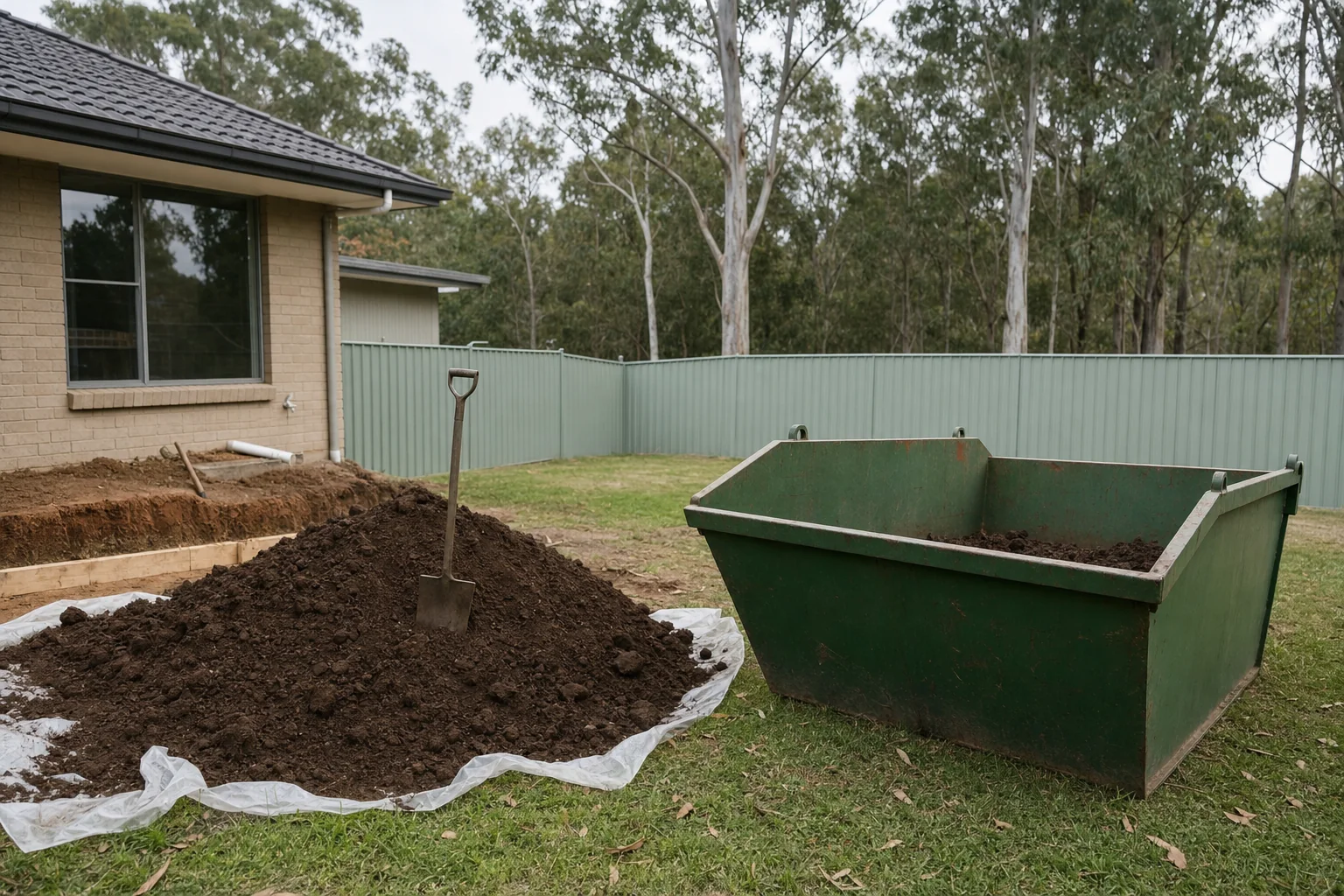
Usually yes, but soil is handled as heavy waste rather than general waste, and that changes almost everything about how a bin is booked. It also has to be genuinely clean to be treated as clean, which is a lower bar than most people assume.
Here's why soil gets its own category, where it can legally go, and the trap on the other side of the transaction when someone offers you free fill.
Why soil is treated differently to everything else
Weight. EPA Victoria publishes conversion factors for commonly stockpiled waste, drawn from the South Australian EPA's measurement standard, and soil comes in at 1.8 tonnes per cubic metre.
Run that out and the problem is obvious. Two cubic metres of soil is around 3.6 tonnes. The same volume of loose garden clippings, at 0.15 tonnes per cubic metre, is around 300 kilograms. A bin that looks barely touched can already be too heavy to lift safely, which is why soil is quoted and handled separately from a general clean-out.
EPA Victoria conversion factors for stockpiled waste
It's also why turf, garden beds and anything with soil still clinging to it adds up faster than people expect in a mixed load.
What actually counts as clean
Two states define it, and the definitions are stricter than the everyday meaning of the word.
New South Wales
The Protection of the Environment Operations Act 1997 defines virgin excavated natural material, or VENM, as natural material such as clay, gravel, sand, soil or rock fines that has been excavated or quarried from areas not contaminated with manufactured chemicals or process residues from industrial, commercial, mining or agricultural activity, and that does not contain sulfidic ores or soils or any other waste.
The NSW EPA is explicit that generators must consider the site's past and present land uses, and the surrounding land, when assessing whether excavated material qualifies. Contamination can arrive from off site, including through groundwater or settled dust.
NSW EPA on virgin excavated natural material
Queensland
Queensland defines clean earth as natural material such as clay, gravel, sand, soil and rock that is not contaminated with waste or a hazardous contaminant. The state is direct about the practical consequence: if the earth contains mixed materials such as concrete or bricks, it no longer qualifies as clean earth.
Worth knowing if you're in Queensland, the automatic waste levy exemption for clean earth delivered to landfill was removed on 1 July 2023, which changed how soil disposal is treated there.
Queensland on the clean earth waste levy exemption change
The practical version
A few bricks, a bit of old concrete, tree roots wrapped in plastic, a length of ag pipe. Any of these can move a load out of the clean soil category and into mixed waste, which is a different classification handled a different way.
If your excavation genuinely is just dirt, say so. If it has building material through it, say that instead. Describing a mixed load as clean soil doesn't save anything, because it gets identified at the facility rather than at your driveway.
Ask us how to classify your load
Where soil can go
The honest answer is that it depends where you are, because facilities, approvals and acceptance criteria are local. The realistic options are a licensed waste or resource recovery facility, a transfer station that accepts soil, or reuse on a site where filling has been approved.
That last one is the important one, and it has rules attached.
If you are receiving fill, read this part
The flip side of getting rid of soil is someone else offering you theirs, often free. The NSW EPA runs a standing community campaign on exactly this, under the heading that free fill can cost you, and its warning is specific.
The EPA describes dishonest operators offering landowners good quality clean fill and then delivering fill containing building waste, chemicals and asbestos, often far more of it than was wanted, before disappearing and leaving the landowner with contaminated land that is expensive to clean up.
Its four steps are worth following properly:
- Check before you start. Ask your council whether filling is allowed and whether you need approval. If you don't get approval, council or the EPA may order you to remove the fill and pay for proper disposal, and they can order landowners and occupiers to do this.
- Ask questions and keep records. Get full contact details and an ABN from anyone offering fill, ask for a written report certifying the quality and origin of the material, ask for testing if you have doubts, and keep every email, quote and invoice.
- Supervise delivery. Inspect loads as they arrive, stage deliveries so there's time to check, record truck registrations and driver details, and keep the property locked when you're not there.
- Stop accepting fill if it contains asbestos, bricks, concrete, wood, glass or plastic, looks a strange colour, or smells bad.
The penalties attached to getting this wrong are not small. The EPA states that disposing of fill illegally can attract up to a $45,000 on-the-spot fine, $10 million in court fines, and 7 years in prison.
NSW EPA campaign on accepting fill
Asbestos in soil
This deserves its own mention because it's the contaminant people least expect in dirt. The NSW EPA advises that if you think you've found asbestos-containing material in the soil in your garden, take the same precautions as if you'd found it inside the house, and contact a licensed asbestos assessor. Don't break it up, and don't spread the soil around while you work out what it is.
NSW EPA on dealing with household asbestos
Booking a bin for soil
Three things make this go smoothly.
- Say it's soil when you book, and say roughly how much. Volume plus material type is what determines the right bin.
- Keep it separate. Don't use the same bin for the excavation and the general rubbish unless you've agreed that's a mixed load.
- Think about placement. A heavy load needs a firm, level surface and clear truck access, and soft ground after rain is a genuine problem for a bin that's going to weigh several tonnes.
How skip bin hire pricing works in Australia
The short version
Soil can go in a bin, but as heavy waste with its own classification, and at 1.8 tonnes per cubic metre weight runs out long before space does. Clean means genuinely clean: in Queensland, a bit of concrete or brick through it means it's no longer clean earth, and in NSW the VENM definition turns on where the material came from as much as what's visible in it. If someone offers you free fill, treat it as a transaction to document rather than a favour to accept.
Tell us what the material actually is and roughly how much there is, and we'll work out what suits before anything gets delivered.