What Size Skip Bin Do I Need? How to Measure Before You Book
By Dylan Anderson ·
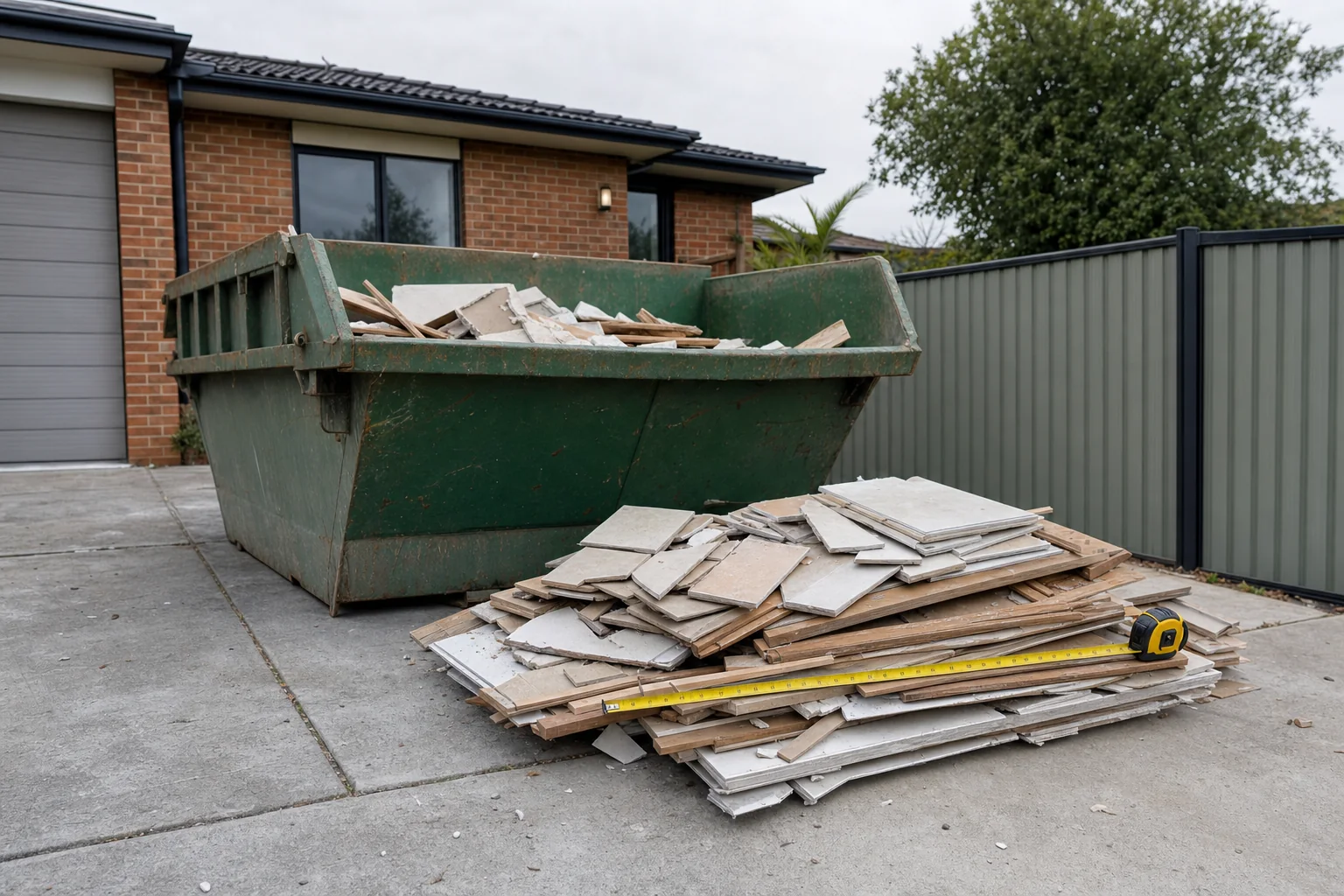
Skip bins are sold by volume, measured in cubic metres. One cubic metre is 1,000 litres, and it's the space a bin holds rather than the weight it can carry. Those are two different limits, and picking the right bin means thinking about both.
What's available varies by supplier and by location, so rather than guess at sizes, this walks through how to work out the volume you've actually got and when weight becomes the deciding factor instead.
Step one: measure what you're throwing out
The most reliable method is also the simplest. Stack the waste roughly where it'll sit, then measure the pile in metres and multiply length by width by height. That gives you cubic metres directly.
A pile 2 metres long, 1.5 metres wide and 1 metre high is 3 cubic metres. If the waste isn't in one heap yet, measure the individual items and add them up. An old lounge, a wardrobe and a stack of boxes are each easy enough to estimate as a box shape.
Add some headroom. Waste stacks unevenly, and awkward shapes like furniture and branches leave gaps that soak up more space than the raw measurement suggests. Rigid items such as timber and cabinetry waste more space than loose material like soil or sand.
Step two: work out whether weight will stop you first
This is the part people miss. A bin has a volume and it has a weight limit, and heavy materials reach the weight limit long before the bin looks full.
EPA Victoria publishes conversion factors for commonly stockpiled waste, drawn from the South Australian EPA's waste measurement standard. They're a useful reality check on what a cubic metre of anything actually weighs.
- Soil: 1.8 tonnes per cubic metre
- Sand or recycled sand: 1.7 tonnes per cubic metre
- Concrete: 1.5 tonnes per cubic metre
- Quarried material such as gravel: 1.4 tonnes per cubic metre
- Bricks: 1.2 tonnes per cubic metre
- Masonry: 1.0 tonnes per cubic metre
- Plasterboard: 0.22 tonnes per cubic metre
- Green waste, garden organics: 0.2 tonnes per cubic metre, or 0.15 loose and 0.26 compacted
EPA Victoria Waste Mass Balance Guideline, conversion factors table
Run the numbers and the problem becomes obvious. Two cubic metres of soil is around 3.6 tonnes. Two cubic metres of loose garden clippings is around 300 kilograms. Same volume, more than ten times the weight.
That's why heavy waste is handled differently to general waste, and why a bin that looks half empty can still be too heavy to lift. If your load is soil, brick, concrete, tiles or sand, weight is your limiting factor and volume is almost beside the point.
Step three: match it to what's actually available
Sizes, weight allowances and what each bin suits differ between suppliers and between locations, because they depend on local facilities, licensing and what the truck can access. Pricing varies the same way. So the useful step is to put your measured volume and your waste type into a quote rather than working from a generic size chart.
Check bin sizes and get a price for your address
When you do, say what the waste actually is. Mixed general waste, clean green waste, clean bricks and concrete, and soil are handled differently, and getting the classification right at the booking stage is what keeps the job straightforward.
Common mistakes worth avoiding
Loading above the rim
The fill line is not a suggestion. A load above the rim can't be safely covered or transported, so the bin may not be collected. Measure with the rim as your ceiling.
Mixing heavy waste into a general load
Half a cubic metre of soil hidden under household junk is close to 900 kilograms. It's a common way to blow a weight limit without realising.
Contaminating a clean load
Clean green waste, clean brick and concrete, and clean soil can be processed rather than landfilled, which is why they're treated as separate categories. Adding general rubbish to a clean load changes what it is.
Forgetting about access
A bin needs a firm, level spot and enough clearance for the truck to place and collect it. Low branches, narrow driveways, soft ground and parked cars are all worth checking before delivery day rather than on the day.
Assuming you can put it on the road
If the only spot is the road, the footpath or the nature strip, a council permit may be required. Rules differ between councils, so check with yours before you book.
A quick worked example
Say you're stripping a bathroom. Tiles and mortar from the walls and floor, the old vanity, a shower screen and packaging.
- Measure the rubble pile: 1.2 metres by 1 metre by 0.5 metres is 0.6 cubic metres.
- Add the vanity and screen, roughly 0.5 cubic metres allowing for the awkward shapes.
- Total volume is around 1.1 cubic metres, so call it 1.5 with headroom.
- Now check the weight. Tile and mortar rubble is masonry, around 1.0 tonnes per cubic metre, so 0.6 cubic metres is roughly 600 kilograms before you add anything else.
- Book on both numbers, and tell the supplier the load includes masonry rubble rather than describing it as general waste.
The short version
Measure the pile, multiply length by width by height, and add headroom for awkward shapes. Then check the weight using the conversion factors above, because heavy material decides the answer long before volume does. Finally, take those two numbers to a quote for your address, since sizes, weight allowances and prices are local and a generic chart won't tell you what you can actually get.
If you're unsure how to classify what you've got, tell us what's in the pile and we'll work it out with you before anything is booked.