Can Solar Panels Go in a Skip Bin? Australian Disposal Guide
By Dylan Anderson ·
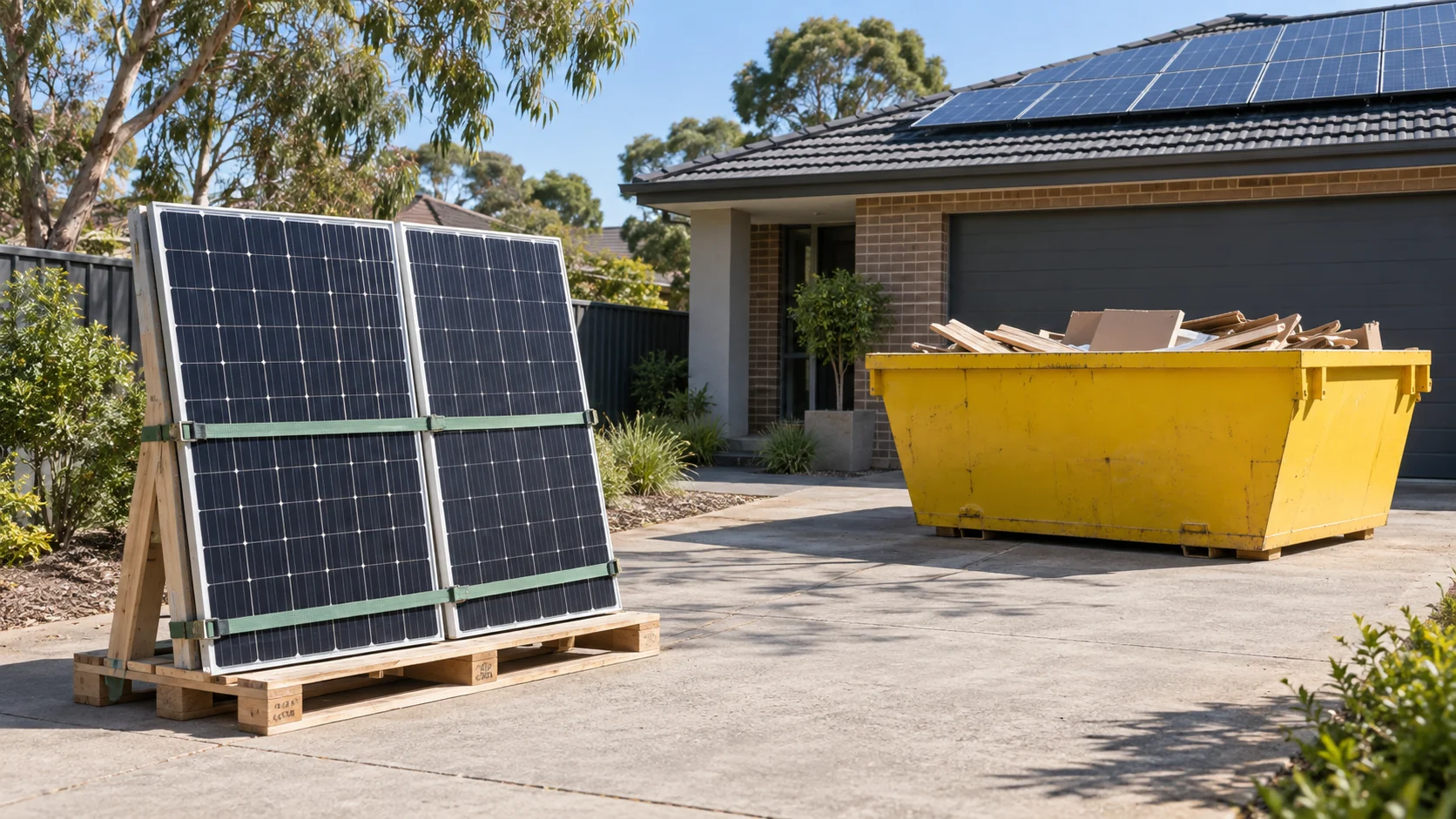
Short answer: old solar panels should not go in a standard skip bin. They are electrical equipment, they need careful handling, and disposal options vary between states, councils and recycling facilities.
If panels are being removed from a roof, arrange the disposal path with the solar retailer or accredited installer before work starts. Do not disconnect or dismantle a solar system yourself. The Australian Government's Solar Consumer Guide recommends using a licensed electrician for removal and asking the retailer or installer to take unwanted components away.
Australian Government Solar Consumer Guide
Why solar panels need a separate disposal plan
A solar panel looks like a sheet of glass in an aluminium frame, but it is a layered electrical product. Recoverable materials can include glass, aluminium, copper and silver. Separating those materials requires specialist equipment and should not be attempted during a household clean-out.
Putting panels into a general skip creates several practical problems. Glass can break while the bin is loaded, moved or tipped. A full-size panel also takes up a lot of space without following the same processing path as timber, bricks or ordinary household rubbish.
There is another reason to check first: the rules are not identical across Australia. Some jurisdictions restrict solar panels or other e-waste from landfill, while individual facilities decide what they can accept. A supplier may be able to arrange a dedicated collection, but that is different from adding panels to a standard mixed-waste booking.
Australia is preparing for much more solar panel waste
Australia's rooftop solar uptake makes this a fast-growing waste question. The Australian Government says about one in three households has rooftop panels. It expects the country to generate around one million tonnes, or about 50 million panels, of solar panel waste by 2035.
In January 2026, the government announced $24.7 million over three years for a National Solar Panel Recycling Pilot. The proposed pilot is designed to collect up to 250,000 panels from about 100 sites and test collection, transport and recycling methods.
Australian Government solar panel recycling pilot
That does not mean every household already has a free local drop-off point. The pilot covers selected locations, and the longer-term national model is still being developed. For now, disposal still needs to be organised with an installer, council, waste facility or specialist recycler that confirms it accepts the panels.
What to do with old solar panels
Use this order when a system is being replaced or removed:
- Contact the solar retailer or installer before the job and ask what happens to the old panels.
- Use a licensed electrician for removal. An installer accredited by Solar Accreditation Australia is a sensible starting point.
- Ask whether working panels can be professionally assessed for reuse.
- If reuse is not suitable, request recycling through the installer or a specialist service.
- If you need to use a council facility, check its current acceptance rules, quantity limits and fees before travelling.
- Keep the panels intact and protected until the approved service takes responsibility for them.
Do not prise apart the frame, junction box or layered panel materials at home. A cracked or fire-damaged panel may need different handling, so tell the installer or facility about its condition before it is moved.
Can a council recycling centre take solar panels?
Sometimes, but never assume it will. Council arrangements can differ even between neighbouring areas.
For example, the City of Ryde in NSW tells residents to contact their solar retailer or installer first and says its local Community Recycling Centre does not currently accept solar panels. Wagga Wagga City Council lists solar panels as an accepted item at its main waste facility for a per-panel fee. These examples show why checking the exact facility matters.
City of Ryde waste and recycling guide
Wagga Wagga accepted waste and fees
Victoria also treats photovoltaic panels as e-waste and bans them from landfill. If you are outside Victoria, do not assume that means a general skip is automatically acceptable. Your supplier still needs to confirm the waste stream and destination.
Sustainability Victoria information on photovoltaic panel recycling
What about the battery and inverter?
A rooftop solar system can leave behind more than panels, and the components do not all follow the same disposal path.
Solar batteries need particular care. The Australian Government advises householders not to uninstall, store or transport an old solar battery themselves. Contact the battery provider or an accredited installer to arrange safe handling. Batteries must never be hidden in a skip load.
Inverters are e-waste too. Depending on local services, they may be accepted by a council facility, an accredited installer or a suitable e-waste recycler. Confirm the service before dropping one off.
For more detail about loose and embedded batteries, read our guide to batteries in skip bins and the NSW rules from October 2026.
Batteries in skip bins and the NSW rules from October 2026
Planning the skip for the rest of the job
Once the solar equipment has its own removal plan, a skip can still be useful for accepted renovation or clean-out waste from the same project.
Tell the skip supplier exactly what remains. Timber offcuts, packaging, roof materials, metal and general household items may need different bin types or pricing. Accepted waste varies by supplier, location and disposal facility, so do not treat one quote as approval for every item on site.
Keep the load below the fill line and watch the weight when roofing, bricks, concrete or soil are involved. Heavy materials can reach a bin's weight allowance well before it looks full. Our Australian skip-bin pricing guide explains the main factors that affect a quote.
Australian skip-bin pricing guide
The short version
Do not put old solar panels into a standard skip bin. Arrange licensed removal, ask the retailer or installer about reuse or recycling, and confirm any council facility's current rules before travelling.
The national recycling pilot is a useful step, but local collection options are still developing. Sort out the panels, battery and inverter first, then check SkipBin.com for a suitable bin for the accepted waste left from your renovation or clean-out. If an item is uncertain, ask before loading it.
Check SkipBin.com for a suitable bin
Sources checked
Australian Government: Replace and recycle your solar system
Department of Climate Change, Energy, the Environment and Water: Solar panels
City of Ryde: A to Z guide of waste and recycling
Sustainability Victoria: Recycling silicon from photovoltaic panels