What Can You Not Put in a Skip Bin? The Australian Exclusions List
By Dylan Anderson ·
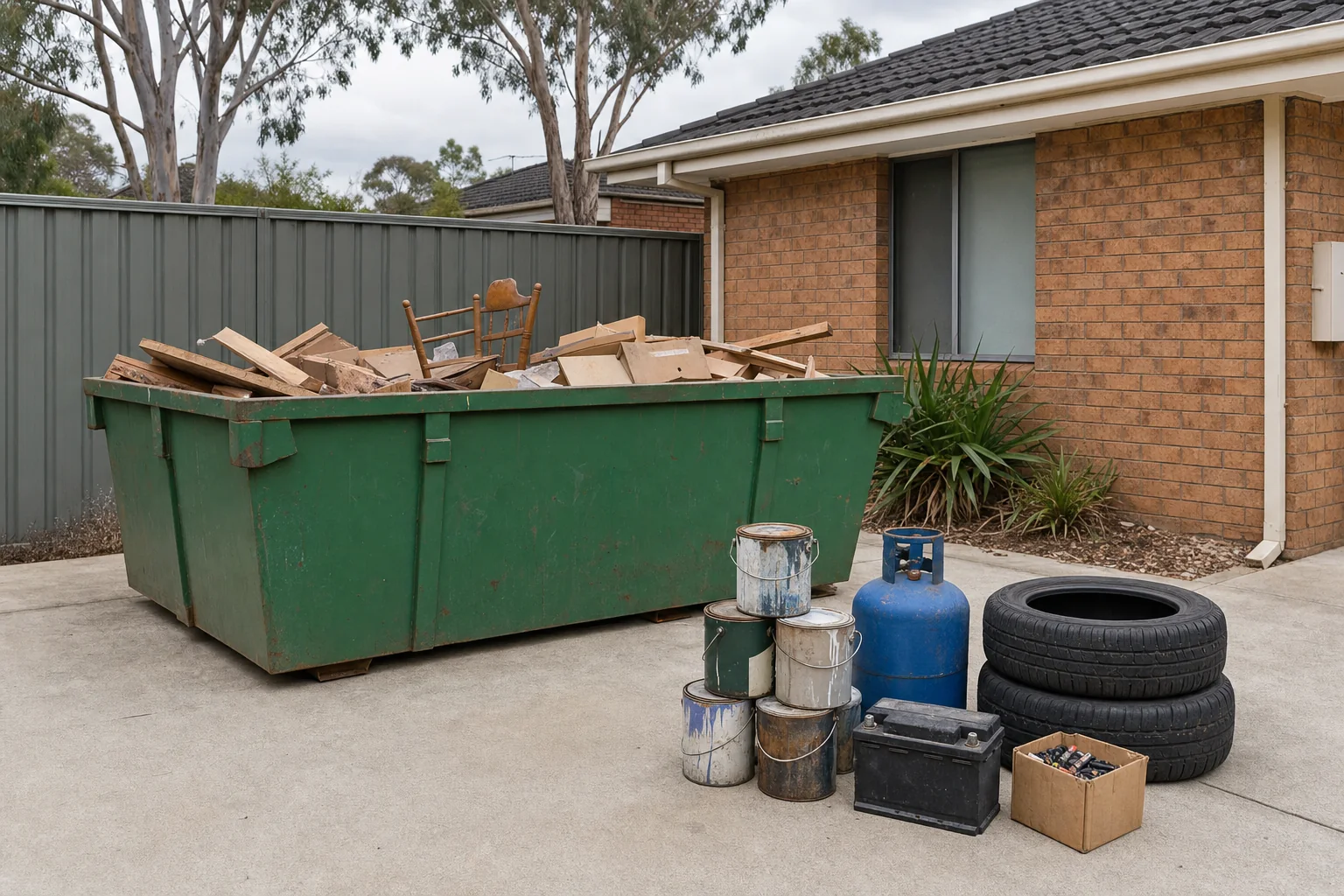
A general skip bin takes most of what comes out of a house or a renovation. The exceptions are the problem, because they're the items that stop a load being tipped, and most of them are things people genuinely don't think twice about.
Start with the rule that sits above all of this: accepted waste varies by supplier, bin type and location. What follows is the list of items that are restricted almost everywhere, why, and where each one actually goes instead. If you're unsure about something specific, ask before it goes in.
Anything with a battery in it
Batteries are the biggest single problem in the waste stream right now. Crushed or punctured lithium-ion cells can go into thermal runaway, which starts fires in trucks, on tipping floors and inside stockpiles. Loose batteries under 5kg go to a B-cycle drop-off point, which is the national scheme. Larger removable batteries, such as those from e-bikes, e-scooters and cordless vacuums, go to a Community Recycling Centre in NSW. Outside NSW, check what your own council or state regulator offers.
Batteries and skip bins, plus the NSW rules
It's not just obvious batteries. Anything with a cell built into it counts, including vapes, cordless vacuums, bluetooth speakers, power banks and electric toothbrushes. Vapes are their own particular hazard because they pair a lithium cell with a heating element.
Why vapes can't go in a skip bin
Fridges, freezers and air conditioners
These hold fluorocarbon refrigerant, which is controlled under Commonwealth law. The gas has to be recovered by someone holding a licence through the Australian Refrigeration Council before the unit is crushed or scrapped. Once it's been properly degassed, what's left is a metal cabinet, and whether that can go in a bin depends on your supplier.
What the law requires before a fridge is scrapped
Solar panels
Panels have their own disposal pathway rather than going into general waste, and enough people ask about it that we've covered it separately.
Asbestos
This one is stated in law rather than left to supplier policy. The NSW asbestos authority lists it as illegal to put asbestos in an uncovered skip bin, or in a skip bin not approved to hold asbestos, as well as illegal to put it in a kerbside bin, to dump it, or to reuse or recycle it. Asbestos waste can only go to a landfill licensed to accept it.
If your house was built before 1990, the NSW EPA says it probably contains asbestos-containing materials, so this is worth ruling in or out before a bathroom or shed job starts rather than during it.
Asbestos, skip bins and what you may remove yourself
Paint
Paint is hazardous waste and shouldn't go in a bin, but Australia has a free national scheme that makes this easy. Paintback accepts unwanted paint and packaging at drop-off locations across the country at no cost, with more than 165 sites according to Planet Ark's Recycling Near You.
There are limits worth knowing before you load the car. Paintback accepts a maximum of 100 litres per visit, carried in secured containers no larger than 20 litres each.
It takes architectural interior and exterior paint, primers, sealers, undercoats, stains and shellacs, varnishes and single-component urethanes, wood coatings, deck and floor paints, and the packaging. It does not take aerosol paints, automotive or industrial coatings, two-component coatings, paint thinners, mineral spirits or solvents, paint washings, adhesives and epoxies, texture or membrane coatings, tar and bitumen products, or painting equipment such as brushes, rollers and trays.
Paintback guidance for households
Gas bottles and cylinders
Never in a bin, and the reason is blunt. Planet Ark's guidance is that pressurised gas bottles should never go in a garbage or recycling bin because if they're compacted in the truck they can explode and cause a fire. That applies to LPG bottles, gas canisters, butane bottles and fire extinguishers.
The options are straightforward. Swap'n'Go is a national cylinder swap service available at selected service stations and retailers where you exchange an empty bottle for a filled one. Household cylinders may also be accepted at household hazardous waste collection points, such as a Community Recycling Centre or a council collection event. Branded industrial cylinders from suppliers like BOC should go back to the manufacturer so rental charges stop, and diving tanks go back through dive centres or refillers.
Planet Ark on recycling gas bottles
Tyres
Tyres are managed as waste tyres once they're used, rejected or unwanted, and that includes casings, seconds and shredded or crumbed rubber. The NSW EPA points to section 143 of the Protection of the Environment Operations Act 1997, which requires waste to be transported to a place that can lawfully accept it, and notes that retailers, retreaders and transporters can each be guilty of an offence where that doesn't happen.
There's also a tracking requirement in NSW for loads of more than 20 tyres or 200 kilograms, recorded through the Integrated Waste Tracking Solution.
For a household, Planet Ark's guidance is that tyres should never go in a household recycling bin, and that they can be recycled at designated collection points or through a mechanic, retailer or dealership accredited by Tyre Stewardship Australia when old tyres are being replaced with new ones. Tyre Stewardship Australia publishes directories of accredited retailers and of accredited recyclers and collectors.
Chemicals, solvents and liquids
Household chemicals, pesticides, pool chemicals, solvents and fuels are handled through household hazardous waste channels rather than general waste, not a skip bin.
In NSW there are two channels. Community Recycling Centres are permanent free drop-off points for household problem waste, and the NSW EPA lists what they take: paint, motor oils and other oils, household batteries, car batteries, gas bottles, smoke detectors, fire extinguishers, and fluoro globes and tubes. Household quantities only, with a guide of a maximum 20 litre or 20 kilogram container for each waste type. Household chemicals themselves go to a Household Chemical CleanOut event instead, which is a mobile service held at various NSW locations through the year.
There are more than 100 Community Recycling Centres in NSW, and most are open to any NSW resident rather than only locals. Businesses are not eligible. Outside NSW, check what your own council and state regulator provide, because these are state-run programs rather than national ones.
NSW EPA on Community Recycling Centres and what they accept
Find a Community Recycling Centre or CleanOut event in NSW
Sharps and medical waste
Needles, syringes and lancets need a sharps container, not a bin. NSW Health advises that sharps bins can typically be found at hospitals, some pharmacies and medical centres, community health centres, and in community sharps bins provided by councils in places like public toilets and parks. For home use you can buy a container meeting Australian standards from many pharmacies.
If you find a sharp that isn't yours, NSW Health is clear: don't touch it. In NSW the Needle Clean Up Hotline is 1800 633 353.
NSW Health on community sharps management
Things that aren't banned but change the load
Separate category, and worth understanding because it's where most unexpected problems come from. These items can usually go in a bin, but they change what the bin is.
Soil, brick, concrete and other heavy waste
Soil runs at about 1.8 tonnes per cubic metre using EPA Victoria's published conversion factors, so weight becomes the limit long before space does. Heavy material is booked and handled differently to a general clean-out.
Soil, dirt and what counts as clean fill
Clean green waste
Green waste is categorised separately from general waste, and it is light. EPA Victoria puts garden organics at 0.2 tonnes per cubic metre, or 0.15 loose. If you have booked a load as clean green waste, adding general rubbish to it changes what that load is, so keep them apart.
Volume and weight generally
If you're not sure how much you've actually got, measure the pile and check the weight before you book rather than guessing from how it looks.
How to work out what size bin you need
Why it matters beyond the inconvenience
A restricted item in a load isn't just a hassle at collection. Waste has to go to a place that can lawfully accept it. To give a sense of scale, the NSW EPA lists maximum penalties for larger-scale strict liability waste dumping offences of $500,000 for an individual and $2,000,000 for a corporation, and states that where the waste contains asbestos the maximum penalty doubles. Other states set their own penalties.
What counts as illegal dumping and what it costs
What if something restricted is already in the bin?
If you find something in your bin that shouldn't be there, whether you put it there or someone else did, don't tip the bin out to sort it and don't handle anything hazardous. Tell your supplier before collection is due, because the load may need to be handled differently. If it was dumped there by someone else, that's worth reporting.
What to do when someone dumps rubbish in your skip
The short version
Batteries and anything containing one, fridges and air conditioners with gas still in them, asbestos, paint, gas bottles, tyres, chemicals and liquids, and sharps all have somewhere else to go, and most of those places are free. Soil, rubble and clean green waste can go in a bin but belong in the right kind of load.
The single most useful habit is to sort the awkward items into a box at the start of a clean-out rather than discovering them at the bottom of a full bin. If there's something in your pile you're not sure about, tell us what it is before you book and we'll sort out the right approach for your location.